August 5, 2026 · 13 min read
The Avatar Mindset: Teaching Your Kid to Coach Their Own Character
In games, kids study their character's stats, spot the weak ones, and grind to level them up, with zero drama. What if they saw their own basketball game the same way? How the avatar mindset builds self-aware athletes who can assess themselves honestly, review their own film, and improve without waiting for a coach to tell them what's wrong.
By WestSide Coaching Staff

Watch a kid play a role-playing game and you'll see something remarkable: honest self-assessment, on demand, with zero drama. They pull up their character's stat sheet, notice the defense rating is low, and go level it up. No excuses, no bruised ego, no waiting for someone to point it out. The character isn't them (it's their avatar) so looking at its weaknesses doesn't hurt.
Now ask that same kid what part of their basketball game needs work, and the honesty often evaporates. Being evaluated feels personal. And that's the insight behind what we call the avatar mindset: teach your player to step outside themselves and look at their own game the way they'd look at a character they're building. We think this is more than a cute metaphor; we'd argue it's where the world is heading, as kids grow up building digital versions of themselves everywhere. But more importantly, it lines up with several real bodies of research about how people evaluate themselves, learn motor skills, and improve without a coach hovering. Here's the science, and how to use it at home.
Why stepping outside yourself works
Psychologists call it self-distancing: viewing your own experience from an observer's perspective instead of from the inside. A long line of research led by psychologist Ethan Kross shows that people reason more calmly and objectively about their own situations when they take that outside view. And there's a beautifully simple way to trigger it. Across seven studies, people who talked to themselves by name or as 'you' ('Okay, Maya, slow down and watch the follow-through') handled stressful performance situations better than people using 'I.' Brain-imaging work found third-person self-talk reduces emotional reactivity essentially for free: it doesn't require extra mental effort. That is the avatar mindset in one sentence: when your kid narrates themselves like a character, the emotional sting drops out and the useful information stays.
The character sheet: what expert athletes do differently
Here's what's striking in the research on how experts practice: the difference isn't just talent or hours, it's self-regulation. In a study of adolescent basketball players practicing free throws, the expert shooters set specific technique goals ('elbow under the ball'), monitored themselves against those goals, and (crucially) attributed misses to fixable strategy rather than to being bad at it. Novices mostly just shot and hoped. A companion study with volleyball players found expert players out-planned, out-monitored, and out-reflected novices at every phase, and their self-regulation scores predicted over 90% of the variance in serving accuracy.
You might object that experts can afford to practice that way because they're already good. Fair, those studies show a difference, not a cause. But researchers closed that loop: when students were explicitly taught the cycle (set a technique goal, self-monitor, reflect on what you did differently) during basketball free-throw practice, they outperformed students who just practiced. Self-assessment is teachable. And in another experiment, learners who logged their own results and graphed them against step-by-step standards built more skill and more confidence than those chasing perfection or tracking nothing. In other words: kids who literally keep their own stat sheet, with realistic next levels instead of impossible ones, get better faster. The RPG kids had it right all along.

- ✓Before practice, one controllable technique goal ('snap the follow-through') not an outcome goal like 'make 8 of 10.'
- ✓Let your player keep their own chart: makes, reps, times. They log it, not you. Ownership is the point.
- ✓Set graduated levels like a game does: beat your last week, not perfection.
- ✓After a miss, train the expert question: 'What did I do differently on that one?', strategy talk, not ability talk.
Film study on yourself, done right
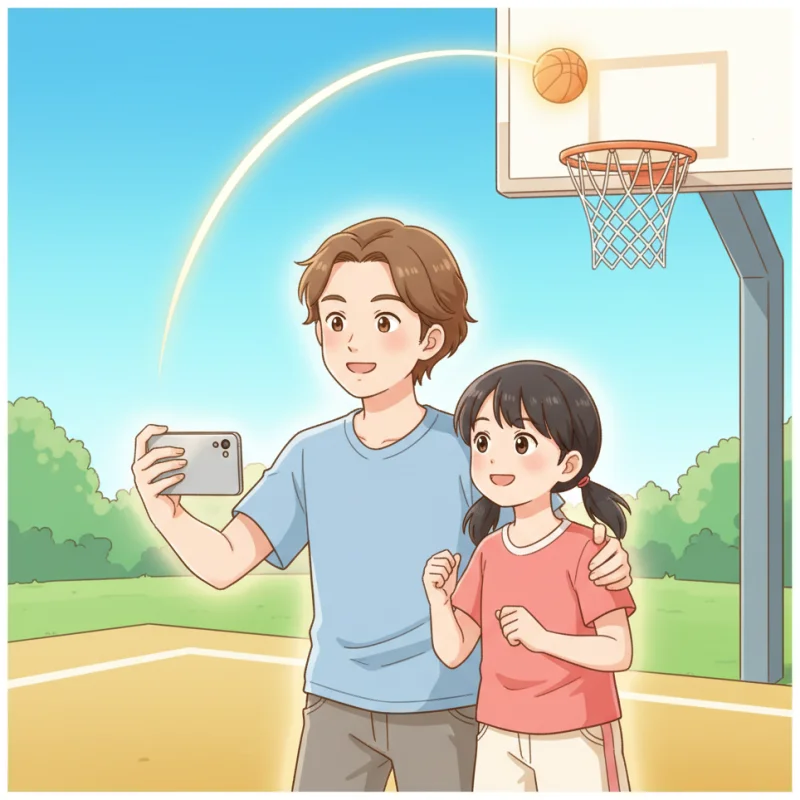
The most direct tool for seeing yourself as an avatar is the camera in your pocket. Sports scientists have studied 'video self-modeling' for decades (Peter Dowrick, the researcher who pioneered it, documented well over a hundred published applications) and reviews in both school and sport settings find that watching video of yourself reliably helps kids learn skills. One study is worth knowing specifically: children learning trampoline routines who watched edited videos showing only their best attempts (a technique called feedforward, essentially a highlight reel of the player you're becoming) performed better than kids given verbal instruction alone.
But the research carries a warning label parents should take seriously. A systematic review of video and other augmented feedback in sport found that while it usually helps, learning can actually get worse when feedback is too frequent or dwells on failure. And unstructured film sessions overwhelm young athletes; kids do best with short clips and one cued thing to watch. So the move is not filming everything and reviewing mistakes on the car ride home. It's the opposite: short clips, best reps, one question.
Does 'being' an avatar really change behavior?
Interestingly, yes, there's even research on the avatar half of the metaphor. Virtual-reality researchers documented what they named the Proteus effect: people conform to the characteristics of the avatar they're given. Participants embodying taller avatars negotiated more confidently; in one study, people cycling in VR as a muscular, athletic avatar reported the exercise felt easier. Reviews put the effect at real but modest, this is a nudge, not a magic trick, and most of these studies were done with adults in labs. But the direction is consistent and useful: the identity your kid rehearses shapes how they act. So let them define their build ('lockdown defender, best passer on the team') and talk about their development as leveling that character up. To be straight with you: nobody has run a study on kids treating themselves as basketball avatars specifically. The avatar frame is our kid-friendly way of combining several things research does support, self-distancing, self-monitoring, and video self-review.
Grinding the right stat
Once your player can see their character sheet honestly, practice changes character too. The famous research on deliberate practice (effortful, targeted work on specific weaknesses with feedback, as opposed to comfortable repetition) found elite performers accumulated far more of it. You've probably heard this as the '10,000-hour rule,' but that number is pop-science folklore the original researcher himself rejected, and you shouldn't repeat it to your kid. Later meta-analyses found deliberate practice explains a meaningful chunk of sports performance (around 18%) but nowhere near all of it, and a careful replication of the original study found a smaller effect than first reported. Two encouraging notes hide in that same research: elite athletes did not start their sport earlier than everyone else (so a multi-sport childhood is scientifically defensible), and quality of practice matters more than raw hours (so thirty focused minutes on the weak hand beats two comfortable hours of shooting around). Aim the grind at the lowest stat. That's what the avatar mindset is for: without honest self-assessment, kids practice what they're already good at, because it feels better.
The player who doesn't need to be told
Here's the long game. A player who can watch their own film calmly, name their weakest stat without shame, set a technique goal, and track their own progress has stopped outsourcing their development. They don't wait for a coach to tell them what's wrong, they bring the coach their own scouting report and ask for help with the fix. Our coaches can spot these kids instantly, and it changes what we can do for them: coaching becomes collaboration instead of correction. That self-awareness doesn't stay on the court, either. A kid who learns at ten that they can look at themselves objectively, find the gap, and close it (kindly, like a player they're rooting for) is carrying around one of the most useful skills a person can have. The avatar isn't an escape from who they are. It's how they learn to see who they're becoming.
Sources & further reading
1. Kross et al. (2014): Self-talk as a regulatory mechanism: How you do it matters
Journal of Personality and Social Psychology, 106(2) · Across seven studies, third-person / own-name self-talk improved emotion regulation and performance under social stress versus first-person.
https://sites.lsa.umich.edu/emotion-selfcontrol-psych/wp-content/uploads/sites/1322/2024/07/KrossJ_Pers_Soc_Psychol2014Self-talk_as_a_regulatory_mechanism_How_you_do_it_matters.pdf2. Moser et al. (2017): Third-person self-talk facilitates emotion regulation without engaging cognitive control
Scientific Reports, 7:4519 · ERP and fMRI evidence that distanced self-talk reduces emotional reactivity without extra mental effort.
https://www.nature.com/articles/s41598-017-04047-33. Kross & Ayduk (2017): Self-distancing: Theory, research, and current directions
Advances in Experimental Social Psychology, Vol. 55 · Review: the observer perspective on one's own experience promotes calmer, more objective self-evaluation.
https://sites.lsa.umich.edu/emotion-selfcontrol-psych/wp-content/uploads/sites/1322/2017/09/Self-distancing-theory-research-future.pdf4. Cleary & Zimmerman (2001): Self-regulation differences during athletic practice by experts, non-experts, and novices
Journal of Applied Sport Psychology, 13(2) · Adolescent expert free-throw shooters set specific technique goals and attributed misses to fixable strategy, not ability. Correlational.
https://www.tandfonline.com/doi/abs/10.1080/1041320017531498835. Kitsantas & Zimmerman (2002): Comparing self-regulatory processes among novice, non-expert, and expert volleyball players
Journal of Applied Sport Psychology, 14(2) · Combined self-regulation measures predicted over 90% of the variance in serving accuracy.
https://www.tandfonline.com/doi/abs/10.1080/104132002529077616. Cleary, Zimmerman & Keating (2006): Training physical education students to self-regulate during basketball free throw practice
Research Quarterly for Exercise and Sport, 77(2) · Experimental: students taught the goal → monitor → reflect cycle outperformed practice-only controls, self-regulation is teachable.
https://www.tandfonline.com/doi/abs/10.1080/02701367.2006.105993587. Kitsantas & Zimmerman (2006): Enhancing self-regulation of practice: the influence of graphing and self-evaluative standards
Metacognition and Learning, 1 · Learners who graphed self-recorded results against graduated (not perfectionist) standards built more skill, self-efficacy, and satisfaction.
https://link.springer.com/article/10.1007/s11409-006-9000-78. Zimmerman (2008): Investigating self-regulation and motivation
American Educational Research Journal, 45(1) · Canonical statement of the forethought → performance/self-observation → self-reflection cycle.
https://journals.sagepub.com/doi/10.3102/00028312073129099. Dowrick (1999): A review of self modelling and related interventions
Applied & Preventive Psychology, 8(1) · Foundational review of video self-modeling, including 'feedforward', edited video of yourself succeeding at a skill you haven't yet mastered.
https://www.sciencedirect.com/science/article/abs/pii/S096218499980009210. Hitchcock, Dowrick & Prater (2003): Video self-modeling intervention in school-based settings: A review
Remedial and Special Education, 24(1) · Across 18 studies, video self-modeling was effective for improving school-age children's skills and behaviors.
https://journals.sagepub.com/doi/abs/10.1177/07419325030240010411. Ste-Marie et al. (2011): Feedforward self-modeling enhances skill acquisition in children learning trampoline skills
Frontiers in Psychology, 2:155 · Children who watched best-attempt-only edits of themselves outperformed verbal instruction alone (measured self-beliefs didn't differ, mechanism unclear).
https://pubmed.ncbi.nlm.nih.gov/21779270/12. Petancevski et al. (2022): The effect of augmented feedback on the performance and learning of gross motor and sport-specific skills: A systematic review
Psychology of Sport and Exercise, 63 · Feedback (incl. video) usually helps, but can degrade learning when too frequent or focused on poor performance.
https://www.sciencedirect.com/science/article/abs/pii/S146902922200145513. Yee & Bailenson (2007): The Proteus Effect: The effect of transformed self-representation on behavior
Human Communication Research, 33(3) · People conform to their avatar's characteristics (e.g., taller avatars negotiated more confidently). Adult VR research; effect is real but modest (later reviews: r ≈ 0.24).
https://onlinelibrary.wiley.com/doi/abs/10.1111/j.1468-2958.2007.00299.x14. Kocur et al. (2021): Physiological and perceptual responses to athletic avatars while cycling in virtual reality
Proceedings of CHI 2021 · Embodying a muscular/athletic avatar lowered perceived exertion during exercise in VR.
https://epub.uni-regensburg.de/51585/1/Kocur%20et%20al.-2021-Physiological%20and%20Perceptual.pdf15. Ericsson, Krampe & Tesch-Römer (1993): The role of deliberate practice in the acquisition of expert performance
Psychological Review, 100(3) · Defined deliberate practice (targeted work on weaknesses with feedback). The '10,000-hour rule' is a popularization Ericsson rejected. Linked via the 2019 replication, which found a smaller effect than originally reported.
https://royalsocietypublishing.org/rsos/article/6/8/190327/68523/16. Macnamara, Moreau & Hambrick (2016): The relationship between deliberate practice and performance in sports: A meta-analysis
Perspectives on Psychological Science, 11(3) · Deliberate practice explained ~18% of sports performance variance; elite athletes did not start their sport earlier than less-skilled peers.
https://journals.sagepub.com/doi/abs/10.1177/1745691616635591
General information for sports families, not medical or psychological advice. Every kid is different; for anything specific to your child, talk to your pediatrician.
Keep reading
Don't Fight the Controller: How NBA 2K Can Help Build Your Kid's Basketball Brain
Kids love video games, and parents wrestle with how much is too much. Our take: stop fighting it and aim it. Choosing games that match your child's sport can turn screen time into basketball IQ, here's what the research actually supports, how the pros use simulation, and the guardrails that keep it healthy.
Standing on the Shoulders of Heroes: Why Every Young Player Needs One
Michael Jordan had David Thompson. Jason Kidd had Magic. Kobe built his whole game frame-by-frame from tapes of the greats. Heroes aren't just posters on a wall, they're how young athletes learn, set goals, and pull themselves forward. The science of role models and how to help your kid use theirs, including the one caveat every parent should know.