August 5, 2026 · 12 min read
Don't Fight the Controller: How NBA 2K Can Help Build Your Kid's Basketball Brain
Kids love video games, and parents wrestle with how much is too much. Our take: stop fighting it and aim it. Choosing games that match your child's sport can turn screen time into basketball IQ, here's what the research actually supports, how the pros use simulation, and the guardrails that keep it healthy.
By WestSide Coaching Staff
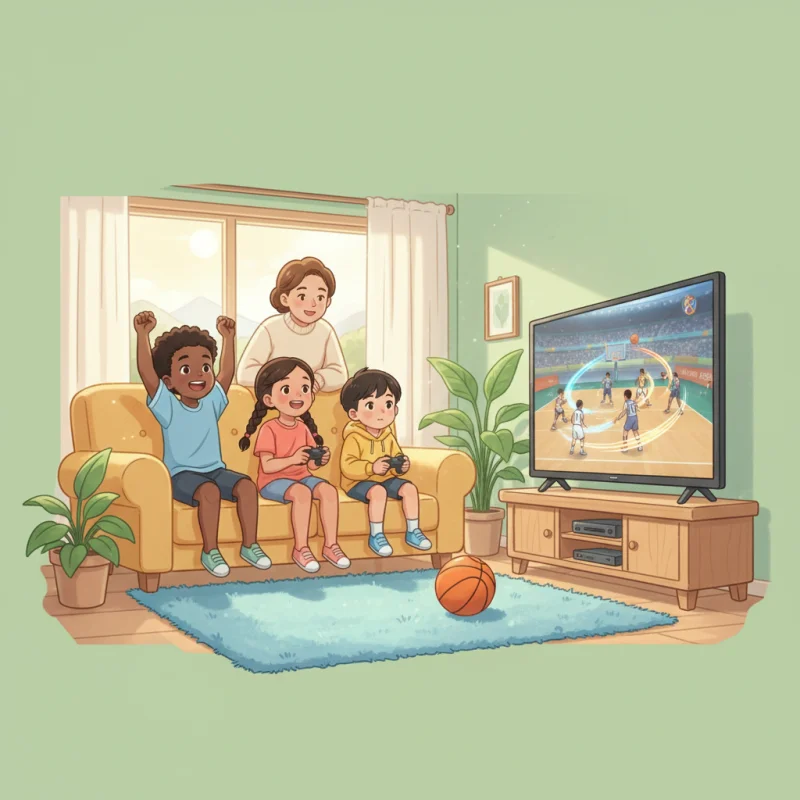
Every sports parent we talk to eventually asks some version of the same two questions: how much video game time should I allow, and which games should my kid even be playing? Gaming is a part of childhood now (it is where kids socialize, compete, and unwind) and pretending otherwise just turns the console into a battleground. After years of coaching young players (and raising our own), we have landed somewhere more useful: instead of fighting the controller, aim it. When the game your child plays on the screen matches the sport they play on the court, screen time can genuinely feed their development as a player.
The simulation idea
Modern basketball games are simulations in the honest sense of the word. NBA 2K models real spacing, real defensive coverages, real play calls, fatigue, shot quality, and tendencies. Played thoughtfully, it drops a child into the perspective of a player in a five-on-five possession over and over: reading a pick-and-roll, recognizing a zone, deciding in half a second whether to swing the ball or attack a closeout. Those are exactly the reads young players struggle to get enough live reps of, because a kid might only see a handful of real trapping defenses in an entire season. In the game, they can see thirty in an afternoon.
This is not a fringe theory. Physical educators have argued for years that commercial sports video games help students pick up the strategies, rules, and tactics of the real sport, and researchers have specifically analyzed NBA 2K as a potential physical-education tool. The best experimental evidence comes from a clever study design: take students who know nothing about a sport, have some of them play the video game version, and test everyone. When researchers did exactly that with cricket (a sport their American college-student subjects genuinely didn't know) the gaming group significantly out-learned the control group on rules, terminology, positions, and field layout, and came away more interested in playing the real sport. That last part matters as much as the knowledge: the game made them want to play.
What the brain science does (and doesn't) say
You may have seen headlines claiming video games sharpen attention and reaction time. There is real research behind them: a well-known Nature study found that habitual action-game players outperformed non-players on tests of visual attention, and follow-up work found gamers made perceptual decisions faster without becoming less accurate: quicker read-and-react, not recklessness. A 2018 meta-analysis pooling fifteen years of studies found gamers averaged about half a standard deviation better on perception and attention measures.
But we owe you the honest version: the science is genuinely debated. A competing meta-analysis published the same year in the same journal concluded that game training does not clearly transfer to general cognitive ability. And most of this research studied fast action games, not sports sims. So we won't promise you that 2K is brain training; nobody can. What the evidence does comfortably support is narrower and, for a basketball family, more useful: sports games teach the sport itself. Rules, spacing, vocabulary, play concepts, and the motivation to get outside and try it for real.
The pros already train this way
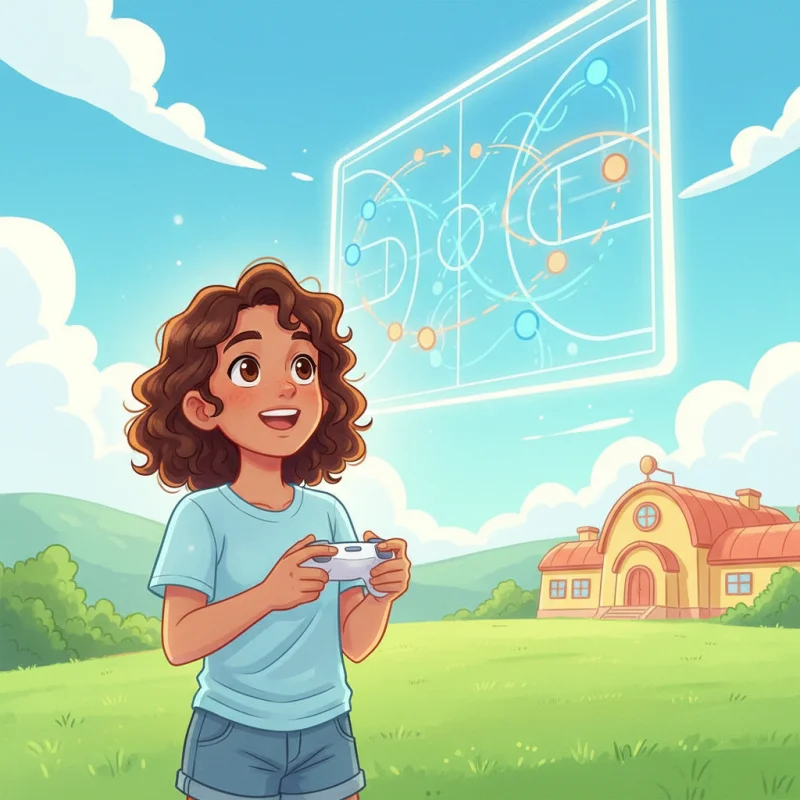
If simulated reps sound like a kid's excuse, consider who else uses them. By 2015, six NFL teams were using STRIVR's virtual-reality system so quarterbacks could rehearse reading defenses without taking hits. Sports Illustrated named it the innovation of the year, and veteran QB Carson Palmer described learning a week's game plan through headset reps at home. The NBA followed: the Washington Wizards' ownership group became the first NBA organization to adopt VR player development, letting players re-read plays from a first-person, on-court perspective, and the league has used VR to train referees. Controlled research is younger but promising: in one randomized trial, people who trained in VR table tennis improved substantially at real table tennis compared to controls.
To be clear about the analogy: a console and a couch are not a pro VR rig, and the pros use simulation for the mental game (reading, recognizing, rehearsing) layered on top of full physical practice. That is exactly the frame we suggest for your player: 2K is film study with a controller. It is a supplement to court time, never a substitute, because no evidence anywhere suggests a controller improves your actual jump shot, handle, or footwork. Shooting is still earned in the driveway.
Making it actually count
The difference between empty hours and useful ones is mostly in how the game is played and what happens around it. A few things we encourage our families to try:
- ✓Favor the thinking modes: playing full five-on-five games, calling plays, or running a franchise beats endlessly grinding a solo character for badges.
- ✓Connect screen to broadcast: when they learn a concept in 2K (a horns set, ice coverage, a 2-3 zone), challenge them to spot it in a real NBA or WNBA game that week.
- ✓Bring one thing to practice: ask your player to name one idea from the game they want to try on the court. Our coaches love hearing 'can we run a pick-and-pop?' from a nine-year-old.
- ✓Play together sometimes: you'll see what they understand, they get to be the expert teaching you, and the time becomes shared instead of solitary.
The guardrails: time, sleep, and safety
Embracing gaming does not mean unlimited gaming. The American Academy of Pediatrics no longer prescribes one universal hour cap for school-age kids; instead it recommends each family set consistent, written limits through a Family Media Use Plan, and its non-negotiables map perfectly onto an athlete's life: about an hour of real physical activity daily, a full night of sleep (8–12 hours depending on age), no console or phone in the bedroom overnight, and screens off in the hour before bed. The World Health Organization draws the same line: at least 60 minutes of moderate-to-vigorous activity a day, with recreational screen time kept in check. Protect those first, and let gaming live in the time that's honestly left over.
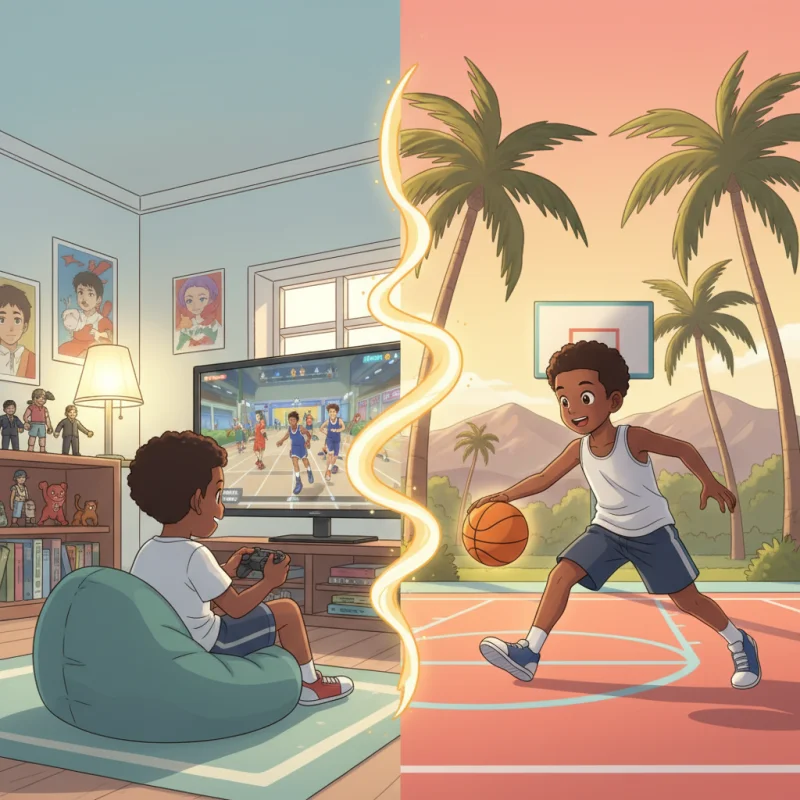
The reassuring news for parents who feel guilty about any screen time at all: the largest study of its kind (120,000 adolescents) found a 'Goldilocks' pattern, where moderate daily play was not linked to lower wellbeing (and was associated with slightly higher wellbeing than none at all), with problems appearing only at heavy levels. Newer studies using actual console play-time data similarly find that hours played, by themselves, are a weak signal of a kid's wellbeing. These are correlations, not guarantees, but they support a calm, moderate approach over an all-or-nothing one.
Two practical safety notes specific to NBA 2K. First, it's rated E by the ESRB, but its online modes include voice and text chat with strangers, every console's parental controls can limit or disable that, and the ESRB publishes step-by-step guides for each device. Second, 2K sells an in-game currency (VC) that kids can burn real money on; require purchase approval on the console so a saved card doesn't become a surprise bill.
The bottom line
Gaming is part of your child's world, and it is only becoming a bigger part of everyone's. You can spend that reality arguing, or you can use it. Point the controller at the sport they love, talk about what they're seeing on the screen, protect sleep and court time, and set the limits together. Do that, and the console stops being the thing that competes with basketball, and becomes one more place your kid is falling in love with the game.
Sources & further reading
1. Jenny, Rademaker, Chung & Schary (2017): Learning a Sport through Video Gaming: A Mixed-Methods Experimental Study
Loading… The Journal of the Canadian Game Studies Association, 10(17) · Randomized experiment: students who played a cricket video game learned significantly more real-sport rules, terminology, and positioning than controls, and became more interested in playing the sport.
https://journals.sfu.ca/loading/index.php/loading/article/download/194/2292. Hayes & Silberman (2007): Incorporating Video Games into Physical Education
Journal of Physical Education, Recreation & Dance, 78(3) · Argues, with early evidence, that commercial sports video games can help students acquire knowledge of real-sport strategies and tactics.
https://files.eric.ed.gov/fulltext/EJ794565.pdf3. IEEE conference study (2021): Invisible Rules in Video Game NBA 2K: Procedural Rhetoric Analysis in a Potential Physical Education Tool
IEEE (conference publication) · Analyzed NBA 2K as a PE tool, including where the game's mechanics teach, and sometimes distort, real basketball ideas.
https://ieeexplore.ieee.org/document/9533082/4. Green & Bavelier (2003): Action video game modifies visual selective attention
Nature, 423, 534–537 · Habitual action-game players outperformed non-players on visual attention tasks; a training study suggested game play drove part of the difference.
https://www.nature.com/articles/nature016475. Green, Pouget & Bavelier (2010): Improved Probabilistic Inference as a General Learning Mechanism with Action Video Games
Current Biology, 20(17) · Action gamers made perceptual decisions faster without losing accuracy.
https://www.cell.com/fulltext/S0960-98221000942-56. Bediou et al. (2018): Meta-analysis of action video game impact on perceptual, attentional, and cognitive skills
Psychological Bulletin, 144(1) · Pooled studies found gamers roughly half a standard deviation better on perception/attention measures; effects smaller in training studies.
https://www.scholars.northwestern.edu/en/publications/meta-analysis-of-action-video-game-impact-on-perceptual-attention7. Sala, Tatlidil & Gobet (2018): Video game training does not enhance cognitive ability: A comprehensive meta-analytic investigation
Psychological Bulletin, 144(2) · Counter-evidence cited for balance: found no convincing causal transfer from game training to general cognitive ability.
https://eprints.lse.ac.uk/102169/8. STRIVR / NFL & NBA adoption (2015–2016): VR quarterback training in the NFL; Washington Wizards first NBA adopter
Harvard Digital Initiative case; Sports Illustrated; NHL.com/Monumental Sports · Six NFL teams used STRIVR VR by late 2015 (SI's Innovation of the Year); Monumental Sports was the first NBA/NHL/WNBA organization to adopt it for player development.
https://d3.harvard.edu/platform-digit/submission/strivr-labs-vr-training-in-nfl/9. Michalski et al. (2019): Getting your game on: Using virtual reality to improve real table tennis skills
PLOS ONE, 14(9) · Randomized trial: VR-trained participants improved real-world table tennis versus controls with large effect sizes.
https://journals.plos.org/plosone/article?id=10.1371%2Fjournal.pone.022235110. AAP Council on Communications and Media (2016): Media Use in School-Aged Children and Adolescents
Pediatrics, 138(5) · Recommends individualized family media plans that protect daily physical activity, 8–12 hours of sleep, device-free bedrooms, and screen-free wind-down before bed.
https://publications.aap.org/pediatrics/article/138/5/e20162592/60321/Media-Use-in-School-Aged-Children-and-Adolescents11. WHO (2020): WHO Guidelines on Physical Activity and Sedentary Behaviour
World Health Organization · Ages 5–17: average at least 60 minutes/day of moderate-to-vigorous activity; limit sedentary recreational screen time.
https://www.ncbi.nlm.nih.gov/books/NBK566046/12. Przybylski & Weinstein (2017): A Large-Scale Test of the Goldilocks Hypothesis
Psychological Science, 28(2) · In 120,115 adolescents, moderate screen use was not linked to lower wellbeing; declines appeared only at high levels. Correlational.
https://journals.sagepub.com/doi/10.1177/095679761667843813. Johannes, Vuorre & Przybylski (2021): Video game play is positively correlated with well-being
Royal Society Open Science, 8(2) · Using real telemetry play-time data, hours played were weakly (slightly positively) related to wellbeing; a 2022 follow-up found play time unlikely to affect wellbeing either way.
https://royalsocietypublishing.org/rsos/article/8/2/202049/95851/Video-game-play-is-positively-correlated-with-well14. ESRB: Game ratings and step-by-step parental control guides
Entertainment Software Rating Board · NBA 2K is rated E; console controls can cap play time, restrict chat with strangers, and require approval for in-game (VC) purchases.
https://www.esrb.org/tools-for-parents/parental-controls/
General information for sports families, not medical or psychological advice. Every kid is different; for anything specific to your child, talk to your pediatrician.
Keep reading
The Avatar Mindset: Teaching Your Kid to Coach Their Own Character
In games, kids study their character's stats, spot the weak ones, and grind to level them up, with zero drama. What if they saw their own basketball game the same way? How the avatar mindset builds self-aware athletes who can assess themselves honestly, review their own film, and improve without waiting for a coach to tell them what's wrong.
Standing on the Shoulders of Heroes: Why Every Young Player Needs One
Michael Jordan had David Thompson. Jason Kidd had Magic. Kobe built his whole game frame-by-frame from tapes of the greats. Heroes aren't just posters on a wall, they're how young athletes learn, set goals, and pull themselves forward. The science of role models and how to help your kid use theirs, including the one caveat every parent should know.