August 5, 2026 · 12 min read
Standing on the Shoulders of Heroes: Why Every Young Player Needs One
Michael Jordan had David Thompson. Jason Kidd had Magic. Kobe built his whole game frame-by-frame from tapes of the greats. Heroes aren't just posters on a wall, they're how young athletes learn, set goals, and pull themselves forward. The science of role models and how to help your kid use theirs, including the one caveat every parent should know.
By WestSide Coaching Staff

Ask almost any great player where it started and you'll hear a name. When Michael Jordan was inducted into the Hall of Fame in 2009, he chose David Thompson (the high-flying NC State star he grew up watching in North Carolina) to present him, telling the crowd he was 'in love with David Thompson… not just for the game of basketball, but in terms of what he represented.' Jason Kidd grew up idolizing Magic Johnson and built his career on the same pass-first joy. And Kobe Bryant, as a ten-year-old in Italy, studied game tapes his grandfather mailed him, then spent a career openly borrowing Oscar Robertson's footwork, Jerry West's pull-up, Olajuwon's post moves, and Jordan's everything. His own summary: 'I seriously have stolen all my moves from the greatest.'
Heroes are one of the oldest human technologies for growth. We use them to define what we want to become, to borrow belief when ours runs short, and (more literally than most parents realize) to learn. The science here is some of the most established in psychology, with one important caveat every sports parent should know. Let's take it in pieces: why watching works, when heroes backfire, and how to help your kid actually use theirs.
Why watching greatness teaches
Psychologist Albert Bandura upended learning theory by demonstrating something every playground already knew: most human behavior is learned by watching others. From observing a model, we form an internal picture of how a skill is performed, and that picture guides our own attempts later. Sport scientists have since built a whole applied field on this. Reviews of 'observation interventions' (structured watching of skilled models, live or on video) consistently find they measurably improve motor skill learning and performance, and a systematic review in school-age physical education came to the same conclusion for kids specifically. When your child watches their favorite player's footwork on a loop, they are not wasting time. They are doing the first half of how humans acquire skills, as long as the second half, physically trying it, follows.
Bandura's research also found that models teach best under certain conditions, the observer has to actually pay attention, and models who are admired or similar to the observer work better. Which brings us to both the superpower and the fine print of heroes.
The caveat: heroes must feel reachable
Here's the finding we most want parents to know. In a classic series of studies, psychologists Penelope Lockwood and Ziva Kunda showed that superstars inspire us only when their success still feels attainable, when it doesn't, the comparison deflates instead of motivates. A related study found that role models similar to ourselves are the ones who buffer our confidence when we're under pressure. An unreachable idol can quietly become evidence that 'I could never do that.'
The fix isn't smaller heroes; it's telling the story differently. Emphasize what the hero looked like at your kid's age: Kobe at ten wasn't a legend, he was a kid squinting at mailed VHS tapes. Jordan's own idol story is about a college kid from his home state, close enough to feel real. Keep a rung within reach. Alongside the NBA poster, point at the high schooler down the street who plays your kid's position, the college player from your town, the teammate two years older. And one more research finding worth sitting with: when adolescents are asked to name their role models, athletes are usually a minority answer. The most common answer, by far, is family, especially parents. Whatever poster is on the wall, the model your kid studies most closely is how you handle effort, frustration, and losing.
Studying the hero's game, Kobe-style
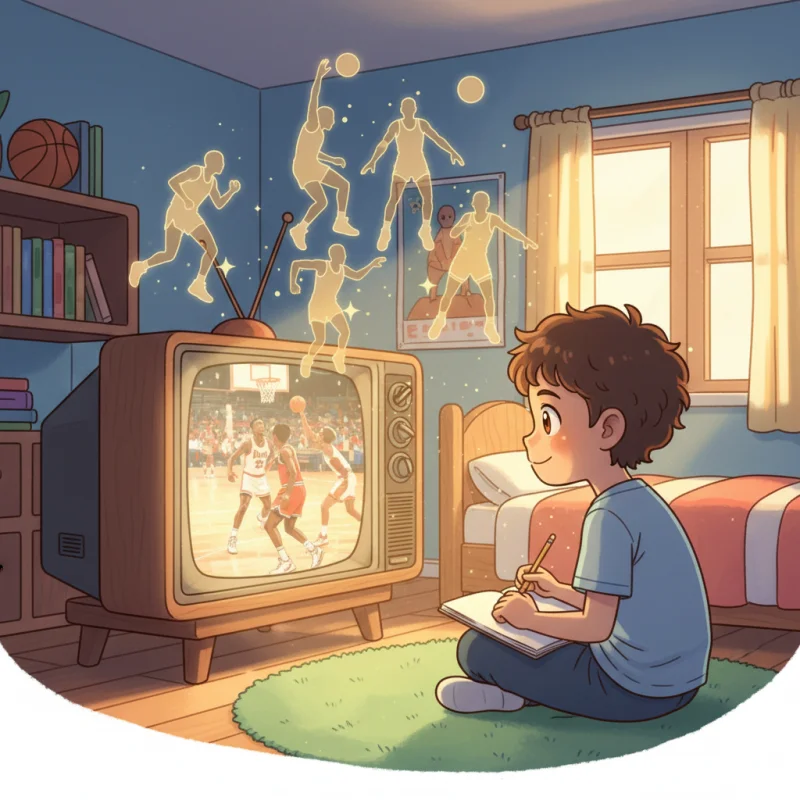
Kobe's tape method is the practical template, and it maps exactly onto what the modeling research prescribes. He didn't watch to be entertained; he watched to take things. A specific pump fake from Oscar. A specific pull-up from West. 'There isn't a move that's a new move,' he liked to say. That's permission for every kid who feels like copying is cheating. Copying greats is how greats are made. Here's how we translate that for a young player:
- ✓Pick one 'study player' per season, ideally someone who plays your kid's position or shares their build or style.
- ✓Keep a moves notebook: one page per habit worth stealing, how they get open, their warm-up, their footwork on the catch.
- ✓Watch one possession at a time, not highlights: what did the study player do away from the ball?
- ✓Steal one move a month and drill it until it stops being theirs and starts being your kid's.
- ✓Study how the hero carries themselves. Jordan loved Thompson for 'what he represented.' Work habits and composure are copyable too.
Closing the loop: seeing it, then being it
There's a final piece that connects heroes to your kid's own body: mental imagery. Meta-analyses spanning three decades (including a modern replication of the classic one) find that mentally rehearsing a skill produces real, if modest, performance gains, and imagery training programs improve sport-specific skills with a clear recipe: roughly ten to twenty-five minutes, a few times a week, over several weeks. Even better, researchers now recommend combining observation with imagery: watch the model execute the move, then immediately close your eyes and feel yourself doing it, the ball's texture, the rhythm, the follow-through. For a kid, that's a bedtime routine: watch the study player hit the move once, then run the tape of yourself doing it in tomorrow's game. None of this replaces physical practice (the research is unanimous there) but as a supplement, it's free, portable, and exactly what a kid daydreaming about their hero is halfway to doing anyway. We're just adding structure to the daydream.
The lineage continues
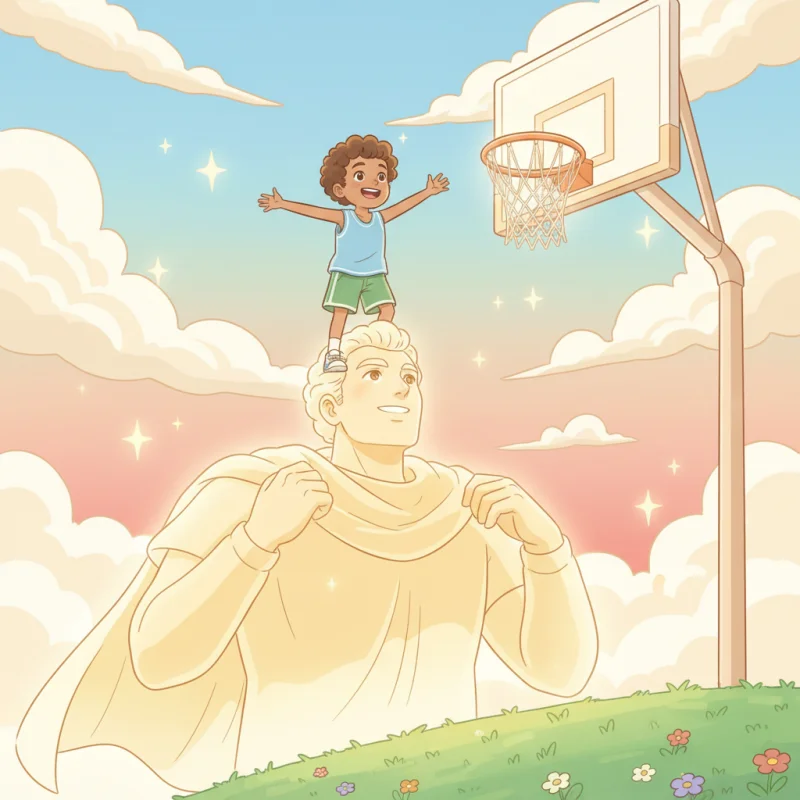
Dr. J inspired a generation. Thompson lit the fire in Jordan; Jordan lit it in Kobe; Kobe lit it in half the league playing today. Every one of those players started as a kid watching somebody and thinking someday. That's not a distraction from player development; it is player development, as old as the game itself. So find out who your kid's hero is (you might be surprised). Put the poster up. Then help them do what the greats actually did with their heroes: study them, steal from them, rehearse being them, and get in enough real reps that one day, some other kid is studying yours.
Sources & further reading
1. Bandura (1977): Social Learning Theory
Prentice Hall · Most human behavior is learned observationally through modeling; learning requires attention, retention, reproduction, and motivation.
https://www.simplypsychology.org/bandura.html2. Ste-Marie et al. (2012): Observation interventions for motor skill learning and performance: an applied model
International Review of Sport and Exercise Psychology, 5(2) · Review: structured observation of skilled models measurably aids motor skill learning and performance in sport.
https://www.tandfonline.com/doi/abs/10.1080/1750984X.2012.6650763. Ste-Marie et al. (2020): Revisiting the Applied Model for the Use of Observation: articles spanning 2011–2018
Research Quarterly for Exercise and Sport, 91(4) · Follow-up review confirming continued support for observation interventions.
https://www.tandfonline.com/doi/abs/10.1080/02701367.2019.16934894. Systematic review (2022): Use of Observational Learning to Promote Motor Skill Learning in Physical Education
International Journal of Environmental Research and Public Health · Observational learning reliably improves motor skill learning in school-age children.
https://pmc.ncbi.nlm.nih.gov/articles/PMC9407861/5. Lockwood & Kunda (1997): Superstars and Me: Predicting the Impact of Role Models on the Self
Journal of Personality and Social Psychology, 73(1) · Superstars inspire only when their success feels attainable; unattainable models can deflate rather than motivate.
http://persweb.wabash.edu/facstaff/hortonr/articles%20for%20class/lockwood%20and%20kunda.pdf6. Lockwood, Jordan & Kunda (2002): Motivation by Positive or Negative Role Models: Regulatory Focus Determines Who Will Best Inspire Us
Journal of Personality and Social Psychology, 83(4) · Gain-oriented (promotion-focused) people (like most aspiring young athletes) are most motivated by positive role models who highlight strategies for success.
https://occupyexcellence.files.wordpress.com/2012/07/lockwood-jordan-kunda-2002.pdf7. Marx & Ko (2012): Superstars 'like' me: The effect of role model similarity on performance under threat
European Journal of Social Psychology · Role models similar to the self protect performance under pressure better than dissimilar superstars.
https://onlinelibrary.wiley.com/doi/abs/10.1002/ejsp.19078. Vescio, Wilde & Crosswhite (2005): Profiling sport role models to enhance initiatives for adolescent girls in physical education and sport
European Physical Education Review · Only ~8% of 357 adolescent girls named a sportsperson as their role model, most named family, especially parents.
https://journals.sagepub.com/doi/abs/10.1177/1356336x050528949. Jordan Hall of Fame speech (2009): Michael Jordan's induction speech. David Thompson as presenter and idol
Naismith Basketball Hall of Fame (transcript) · Jordan, in his own words: 'I was in love with David Thompson… in terms of what he represented.'
https://speakola.com/sports/michael-jordan-hall-of-fame-induction-200910. MacMullan / ESPN (2010): Kobe perfected his game by watching film
ESPN · From ~age 10, Bryant frame-by-frame studied tapes and deliberately borrowed moves from Robertson, West, Baylor, Olajuwon, and Jordan: 'I seriously have stolen all my moves from the greatest.'
https://www.espn.com/nba/playoffs/2010/columns/story?page=kobefilmstudy-10060411. Sports Illustrated: How Jason Kidd compared to fellow all-time great point guard Magic Johnson
SI.com · Kidd has repeatedly named Magic Johnson (along with his father) as his childhood idol.
https://www.si.com/nba/nets/onsi/old-school/how-jason-kidd-compared-to-fellow-all-time-great-point-guard-magic-johnson12. Driskell, Copper & Moran (1994): Does mental practice enhance performance?
Journal of Applied Psychology, 79(4) · Classic meta-analysis: mental practice has a positive, significant effect on performance.
https://www.semanticscholar.org/paper/Does-mental-practice-enhance-performance-Driskell-Copper/a5011fa801a9fd7e446af1131c27b5aa0bffdbdc13. Toth et al. (2020): Does mental practice still enhance performance? A 24-year follow-up and meta-analytic replication
Psychology of Sport and Exercise, 48 · Replication: mental practice still yields moderate performance benefits across expertise levels; multi-week programs work best.
https://www.sciencedirect.com/science/article/abs/pii/S146902921930153014. Meta-analysis (2023): Mental imagery training programs for developing sport-specific motor skills
Physical Education and Sport Pedagogy, 28(4) · Effective imagery protocols ran ~1–6 weeks, ~3x/week, 10–25 minutes per session.
https://www.tandfonline.com/doi/abs/10.1080/17408989.2021.199129715. AOMI recommendations (2021): Recommendations for Combining Action Observation and Motor Imagery Interventions in Sport
Journal of Sport Psychology in Action · Watching a model and then imagining yourself performing the movement can be combined for additive benefit.
https://www.tandfonline.com/doi/full/10.1080/21520704.2021.1971810
General information for sports families, not medical or psychological advice. Every kid is different; for anything specific to your child, talk to your pediatrician.
Keep reading
Don't Fight the Controller: How NBA 2K Can Help Build Your Kid's Basketball Brain
Kids love video games, and parents wrestle with how much is too much. Our take: stop fighting it and aim it. Choosing games that match your child's sport can turn screen time into basketball IQ, here's what the research actually supports, how the pros use simulation, and the guardrails that keep it healthy.
The Avatar Mindset: Teaching Your Kid to Coach Their Own Character
In games, kids study their character's stats, spot the weak ones, and grind to level them up, with zero drama. What if they saw their own basketball game the same way? How the avatar mindset builds self-aware athletes who can assess themselves honestly, review their own film, and improve without waiting for a coach to tell them what's wrong.